
BoryTinnitus Care Service | Bory Tinnitus Analysis and Management Service |
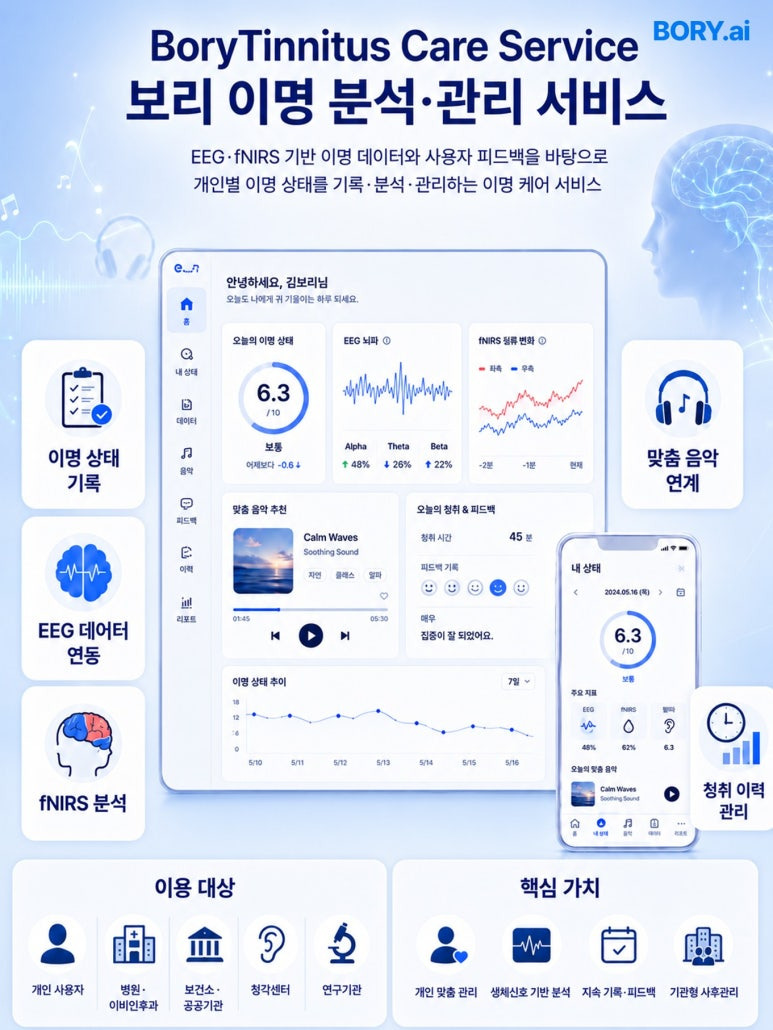
Bory's tinnitus care service records, analyzes, and manages each user's tinnitus condition based on EEG·fNIRS tinnitus data and user feedback, and connects it to personalized music management services.
Service Overview
BoryTinnitus Care Service is Bory's tinnitus analysis and management service that records and analyzes tinnitus conditions based on the user's tinnitus type, tinnitus frequency, tinnitus intensity, living environment, listening history, and EEG·fNIRS biosignal data, and connects these data to personalized management workflows and customized music services.
Through the development of a personalized music generation service for tinnitus relief using EEG data, Bory has secured capabilities in EEG analysis, tinnitus-frequency-based masking-track generation, the Songle web-based composition and listening service, BLE·WebSocket-based real-time data collection, and automated improvement based on user feedback. In addition, its fNIRS Bluetooth band development materials propose entering tinnitus sound type and symptom severity, transmitting cerebral blood-flow data to a server, and analyzing the data with machine learning.
BoryTinnitus Care Service organizes these research and development outcomes into a customer-facing service. Users can routinely record their tinnitus condition and review biosignal-based analysis results, recommended music, listening feedback, and management history. Hospitals, public health centers, hearing centers, and research institutions can use institutional accounts to manage each user's condition and service usage.
AI 활용
Service Definition
A product is a predefined H/W·S/W package, a solution is a system built for a customer's environment, and a platform is a shared technology foundation used to repeatedly create multiple products and services. A service is the customer touchpoint that users actually access and use, where data and feedback continuously accumulate.
BoryTinnitus Care Service does not refer only to a tinnitus analysis device or a music generation function. It is a tinnitus management service encompassing tinnitus condition input, EEG·fNIRS data collection, biosignal analysis, tinnitus type management, personalized music recommendations, listening history, user feedback, institutional management, and report delivery.
Customer Challenges
It is difficult to objectively record and manage tinnitus conditions.
Because tinnitus involves subjective sounds and significant discomfort perceived by the user, hospitals and institutions often rely on the user's verbal description. A structure is needed that enables users to routinely record and manage their tinnitus type, frequency, intensity, and occurrence context.
Tinnitus sounds and responses vary from person to person.
Tinnitus can be experienced in many forms, including high-pitched, low-pitched, pulsatile, mechanical, whistling, or cicada-like sounds. Since users respond differently even to the same music or masking sound, individualized data-based management is required.
Biosignal data is not automatically connected to service management.
Even when EEG or fNIRS data is collected, its ongoing service value is limited unless it is connected to user profiles, music recommendations, listening responses, and management reports.
It is difficult to continuously explore music that may relieve tinnitus.
Users may struggle to find suitable masking sounds and music, and it is also difficult to record which music was helpful after repeated listening. A management service should operate music recommendations together with listening feedback.
Post-care management and data accumulation are difficult for hospitals and institutions.
After tinnitus counseling or auditory rehabilitation, institutions have difficulty checking the user's condition at home or in daily life, what music the user listened to, and what changes occurred.
|
Component
|
Description
|
|
User profile management
|
Manages tinnitus type, sound characteristics, tinnitus frequency, symptom severity, occurrence location, daily-life context, and preferred music.
|
|
Tinnitus condition logging
|
Users record tinnitus intensity, discomfort, sleep and concentration status, and changes before and after listening by day and situation.
|
|
EEG data integration
|
Connects BLE-based EEG sensors to an app and WebSocket server to collect and analyze brainwave data.
|
|
fNIRS band integration
|
Integrates with an fNIRS Bluetooth band or developer kit to expand tinnitus management data based on cerebral blood flow.
|
|
Biosignal analysis
|
Analyzes EEG feature values such as alpha, beta, gamma, delta, and theta, as well as changes in fNIRS blood flow.
|
|
Music recommendation and integration
|
Integrates with Songle Tinnitus Service to recommend music based on tinnitus frequency and user responses.
|
|
Listening history management
|
Records generated tracks, recommended tracks, masking sounds, listening time, satisfaction, and perceived changes.
|
|
Institutional management dashboard
|
Hospitals, public health centers, and hearing centers can review each user's condition, data collection history, listening history, and feedback.
|
|
Reports and counseling materials
|
Provides individual management reports, counseling reference materials, and institutional statistics.
|
Service Structure
Key Features
1. Tinnitus profile registration
Users can register their tinnitus sound type, tinnitus frequency, occurrence location, symptom severity, time of occurrence, living environment, and existing management methods. In the institutional service, counselors can manage user profiles together with the users.
2. Daily tinnitus condition logging
Users can record tinnitus intensity, discomfort, sleep condition, stress, concentration, and perceived changes before and after listening to music throughout the day. Repeated records reveal the user's tinnitus management patterns.
3. EEG-based tinnitus analysis
The service extracts major EEG band features such as alpha, beta, gamma, delta, and theta and uses them to analyze tinnitus presence, tinnitus responses, and conditions before and after listening. EEG data may serve as a supplementary indicator for music listening and feedback management.
4. Expansion to fNIRS-based cerebral blood-flow management
When integrated with an fNIRS Bluetooth band, cerebral blood-flow change data can be used for tinnitus condition management. Tinnitus sound type, symptom severity, and cerebral blood-flow data are accumulated together to expand personalized management models.
5. Analysis of tinnitus type and symptom severity
Based on user-input and biosignal data, the service organizes tinnitus type, symptom severity, situational changes, and recurring patterns. The analysis results are provided as reference information for user management and counseling support, not as a diagnosis.
6. Personalized music recommendation integration
By integrating with Songle Tinnitus Service, the service connects tinnitus frequency, preferred masking sounds, listening responses, and biosignal data to personalized music recommendations and masking-track generation.
7. Listening history and feedback management
Records what music the user listened to, how the perceived tinnitus changed after listening, and which masking sounds felt comfortable. Accumulated feedback is used to improve subsequent recommendations and music generation conditions.
8. Institutional user management
Hospitals, public health centers, hearing centers, and research institutions can review user profiles, biosignal collection history, listening history, feedback, and reports. These can be used as management materials before and after counseling.
9. Automatic report generation
Organizes changes in tinnitus condition, listening history, biosignal summaries, user feedback, and recommended music history into reports. Reports can be configured as personal management reports or institutional counseling reference reports.
10. Data-driven service enhancement
Continuously improves recommendation quality, music generation conditions, UI guidance, and user flows based on accumulated user data and feedback.
Service Use Flow
- The user signs up for BoryTinnitus Care Service or is registered under an institutional account.
- The user enters a basic profile including tinnitus sound type, tinnitus frequency, symptom severity, and occurrence context.
- When necessary, the user wears an EEG sensor or fNIRS band to collect biosignal data.
- The service analyzes user-input and biosignal data and organizes tinnitus management information.
- The service recommends suitable music, masking sounds, and listening content, or connects the user to Songle Tinnitus Service.
- The user listens to the music and records perceived changes, satisfaction, and any discomfort.
- The service manages listening history and feedback and reflects them in subsequent recommendations and reports.
- In the institutional service, counselors or administrators review each user's management status and reports.
Target Users
|
Target Users
|
Use Case
|
|
Individual users
|
Users who want to continuously record their tinnitus condition and find music and masking sounds suited to them
|
|
Hospitals and ENT clinics
|
Institutions that want to review users' daily management and music listening history after tinnitus counseling
|
|
Public health centers and public institutions
|
Institutions conducting tinnitus management, hearing assistance for older adults, or digital healthcare pilot projects for local residents
|
|
Hearing centers and speech/auditory rehabilitation institutions
|
Institutions seeking to operate auditory rehabilitation, hearing loss and tinnitus counseling, and user feedback management services
|
|
Research institutions and universities
|
Institutions seeking to study EEG·fNIRS-based tinnitus response data and music response data
|
|
Healthcare and wellness companies
|
Companies seeking to add tinnitus management functions to sleep, meditation, mental care, or wearable services
|
Service Type
|
Service Type
|
Description
|
|
Personal service
|
Individuals record tinnitus conditions and use music recommendation, listening, and feedback functions on the web or in an app.
|
|
Institutional service
|
Hospitals, public health centers, and hearing centers manage user accounts and review counseling reference reports.
|
|
Research service
|
Manages EEG·fNIRS data collection, music response data, and user feedback data for research purposes.
|
|
Device-integrated service
|
Integrates with BoryTinnitus Band, fNIRS Developer Kit, EEG sensors, and mobile apps.
|
|
Music-integrated service
|
Integrates with Songle Tinnitus Service and expands into personalized masking tracks, modified tracks, and tinnitus-relief music.
|
Integrated Products, Solutions, and Platforms
BoryTinnitus Band
Integrates with an EEG- or fNIRS-based tinnitus analysis band to collect user biosignal data and use it for tinnitus condition management and music recommendations.
Songle Tinnitus Service
Integrates with the EEG-based personalized tinnitus-relief music generation service, connecting the user's tinnitus frequency, masking-sound preferences, and biosignal responses to music generation.
BoryBioSignal Platform
Integrates with a platform for collecting, analyzing, and managing biosignals such as EEG and fNIRS to expand the tinnitus data analysis framework.
Bory fNIRS Solution / Developer Kit
Expands fNIRS-based cerebral blood-flow data collection and analysis capabilities into tinnitus management data.
BORY AI Platform
Integrates as the higher-level AI foundation for biosignal analysis, recommendation algorithms, music generation, data visualization, and report automation.
Expected Benefits
Structured personalized tinnitus management
Continuously records the user's tinnitus condition, listening history, feedback, and biosignal data to create a personalized management workflow.
Enhanced biosignal-based management
Uses EEG and fNIRS data to manage supplementary biosignal-based indicators together, rather than relying only on simple questionnaires or memory.
Seamless connection to personalized music services
Tinnitus conditions and feedback collected by BoryTinnitus Care Service can be connected to the music recommendation and generation workflow of Songle Tinnitus Service.
Stronger institutional follow-up care
Hospitals, public health centers, and hearing centers can review each user's management history and reports for counseling and follow-up care.
Data-driven service improvement
By accumulating user feedback and biosignal response data, recommendation algorithms, music generation conditions, UI/UX, and institutional reports can be continuously improved.
Expansion of Bory's tinnitus and biosignal business
By connecting tinnitus bands, Songle Tinnitus, BoryBioSignal Platform, and the fNIRS Developer Kit, Bory can expand its hearing-assistance and healthcare service lineup.
Operating Process
|
Stage
|
Details
|
|
User registration
|
Registers the user with an individual or institutional account and enters a basic tinnitus profile.
|
|
Data collection
|
Collects tinnitus condition records, EEG·fNIRS biosignals, music listening history, and user feedback.
|
|
Analysis and summary
|
Analyzes and summarizes tinnitus type, symptom severity, biosignal features, and changes before and after listening.
|
|
Recommendation and integration
|
Provides music recommendations, masking-sound selection, and Songle Tinnitus integration suited to the user's condition.
|
|
Report delivery
|
Provides personal management reports and institutional counseling reference reports.
|
|
Service improvement
|
Improves recommendation quality and user experience based on accumulated data and feedback.
|
What BoryTinnitus Care Service Can Do
- Provide a tinnitus condition logging service
- Manage tinnitus type, frequency, and symptom severity
- Manage EEG-based tinnitus response data
- Expand tinnitus management data using fNIRS cerebral blood-flow data
- Manage feedback before and after tinnitus-related listening
- Integrate tinnitus-relief music recommendations
- Manage listening history for masking sounds and personalized music
- Generate personalized tinnitus management reports
- Provide institutional management dashboards for hospitals, public health centers, and hearing centers
- Support collection of tinnitus and biosignal data for research
- Integrate with BoryTinnitus Band and fNIRS bands
- Integrate music generation with Songle Tinnitus Service
- Integrate biosignal analysis with BoryBioSignal Platform
Adoption Inquiries
BoryTinnitus Care Service is available as a personal service, an institutional management service, a research data collection service, a biosignal-device-integrated service, and a service integrated with Songle Tinnitus music services.
- Inquiry about Bory tinnitus analysis and management service
- Inquiry about institutional adoption by hospitals, public health centers, and hearing centers
- Inquiry about EEG·fNIRS-based tinnitus management service
- Inquiry about BoryTinnitus Band integration
- Inquiry about Songle Tinnitus Service integration
- Inquiry about tinnitus management reports and counseling materials
- Inquiry about research tinnitus and biosignal data collection
- Request a PoC or joint development proposal
Important Information
BoryTinnitus Care Service supports tinnitus condition logging, biosignal-based analysis assistance, music recommendation and listening history management, and user feedback management.
This service is not presented as a substitute for medical-device diagnosis, disease treatment, prescriptions, or medical judgment.
EEG·fNIRS analysis results, estimated tinnitus types, music recommendations, and report contents are reference information supporting user management and counseling; medical judgment requires review by qualified healthcare professionals.
Tinnitus symptoms, listening responses, and biosignal results may vary depending on the user's condition, measurement environment, sensor fit, data quality, and music listening environment.
When personal information, health information, biosignal data, or counseling records are stored or analyzed, prior agreement is required regarding privacy standards and data security policies.
Before adopting the institutional service, the data collection method, user consent, retention period, access permissions, report scope, and standards for medical wording must be reviewed.
Related Products, Solutions, Platforms, and Services
|
Category
|
Item
|
|
Related products
|
BoryTinnitus Band / Bory EEG-Based Tinnitus Analysis Band
Bory fNIRS Developer Kit / Cerebral Blood-Flow Measurement Developer Kit
|
|
Related solutions
|
BoryTinnitus Solution / Bory Tinnitus Biosignal Analysis Solution
Bory fNIRS Solution / Bory fNIRS Cerebral Blood-Flow Data Analysis Solution
BoryAudio Solution / Bory Audio Analysis and Generation Solution
|
|
Related platforms
|
BoryBioSignal Platform / Bory Biosignal and fNIRS Analysis Platform
BORY AI Platform / Bory Artificial Intelligence Platform
BoryData Platform / Bory Data Analytics Platform
|
|
Related services
|
Songle Tinnitus Service / Bory EEG-Based Personalized Tinnitus-Relief Music Service
Songle / AI Music Composition Service
SpeechMate / Voice and Speech Therapy Training Service
|
BORY.ai Key Services Overview
Bory Co., Ltd. develops products, solutions, platforms, and services for industrial, medical, public-sector, healthcare, and barrier-free applications based on AI technologies involving speech, language, video, sensors, and data.
Below are the main representative domains currently operated or being prepared by Bory Co., Ltd.
| Primary Domain | Service/Brand | Description |
| bory.ai | BORY.ai | The official AI brand website of Bory Co., Ltd., serving as the company’s main website for the integrated presentation of its products, solutions, platforms, and services |
| borysense.com | BORY SENSE | An AI-powered hearing assistance platform that supports communication for people with hearing disabilities and older adults through real-time captioning, lip-reading AI, and AR glasses integration |
| borytalk.com | BORY TALK | A web-based conversational AI chatbot service designed for civil service inquiries, consultations, information guidance, and customer support |
| borykiosk.com | BORY KIOSK | A barrier-free AI kiosk service for older adults and people with disabilities, featuring voice guidance, captioning, and easy-to-use interfaces |
| boryservice.com | BORY SERVICE | A service portal introducing Bory’s AI services and custom-built AI offerings for industrial, public-sector, and everyday applications |
| borysong.com | BORY SONG | A music AI service that supports AI-powered composition, music generation, and sound content production |
'English > Service(서비스)' 카테고리의 다른 글
| Bory Clinical Laboratory Real-Time Operations Monitoring Service (0) | 2026.07.28 |
|---|---|
| Bory Patient Safety AI Monitoring Service (0) | 2026.07.28 |
| Bory EEG-Based Personalized Music Service for Tinnitus Relief (0) | 2026.07.28 |
| Bory Real-Time Industrial Safety Alert and Monitoring Service (0) | 2026.07.28 |
| Bory Accident Cause Prediction and Monitoring Service (0) | 2026.07.28 |






최근댓글