
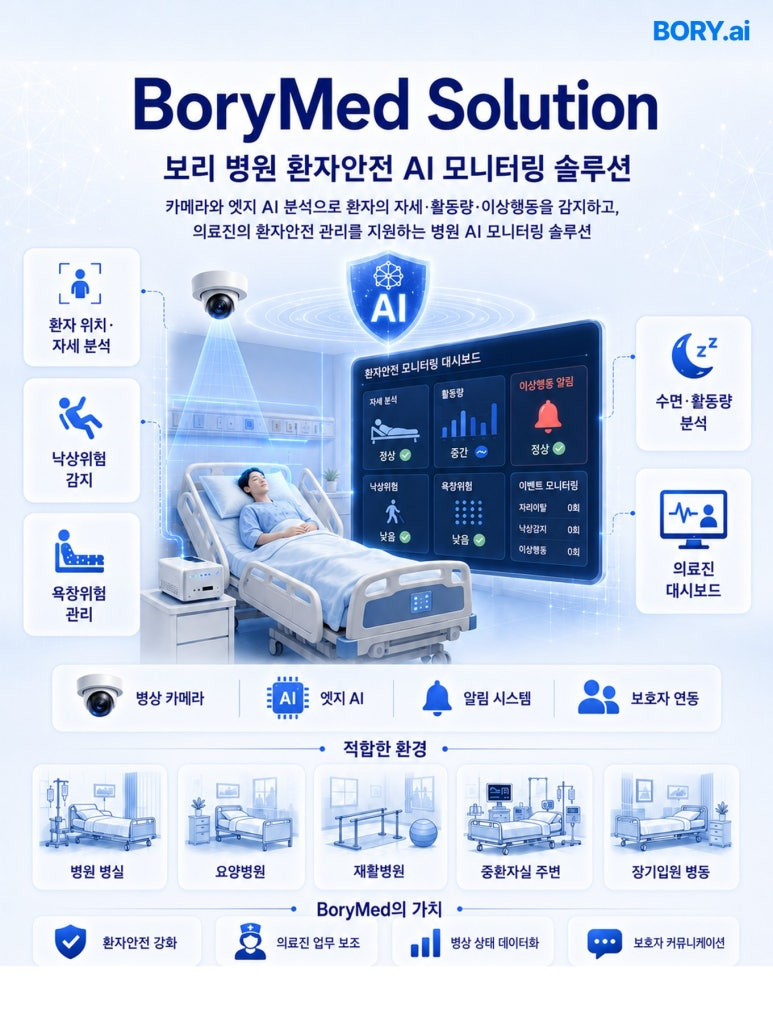
BoryMed Solution | Bory Hospital Patient Safety AI Monitoring Solution |
A hospital AI monitoring solution that uses cameras and edge AI analytics to detect patient posture, activity levels, and abnormal behavior, supporting healthcare staff in patient safety management
BoryMed Solution is a hospital patient safety AI monitoring solution tailored to medical environments such as hospital rooms, long-term care hospitals, rehabilitation hospitals, areas around intensive care units, and long-stay wards. It uses AI to analyze patient posture, location, activity levels, fall risk, pressure injury risk, sleep status, abnormal behavior, and bedside events, enabling healthcare staff and guardians to monitor patient conditions.
In hospitals, it is important to quickly identify patient falls, prolonged maintenance of the same posture, bed exits, abnormal behavior during sleep, signs of pain or discomfort, and approaches by guardians or caregivers. However, healthcare staff cannot continuously check every bed in person, and conventional CCTV systems often only display video without automatically interpreting the patient's condition.
BoryMed Solution integrates bedside cameras, dual cameras, edge AI devices, patient-status analytics algorithms, servers, administrator dashboards, healthcare staff screens, guardian screens, and alert systems to suit each hospital's environment.
Based on the hospital's internal network, bed layout, personal-data processing standards, nursing workflow, and guardian notification policy, the solution can be proposed as a PoC, a per-bed deployment, ward-wide integrated monitoring, guardian app integration, or hospital system integration.
[Solution Introduction Inquiry][Hospital Patient Safety AI Monitoring Consultation][PoC Deployment Inquiry][Request a Proposal]
Customer Challenges
Healthcare staff cannot continuously monitor every bed
Hospitals and care facilities must manage the conditions of multiple patients simultaneously. Fall risk, bed exits, prolonged fixed postures, and abnormal behavior during sleep must be identified quickly, but healthcare staff cannot directly monitor every bed in real time.
BoryMed Solution detects changes in patient condition as events through bedside cameras and AI analytics, helping healthcare staff prioritize situations that require attention.
Conventional CCTV cannot interpret patient conditions
Conventional CCTV systems often do little more than store video or display live footage.
Beyond simple video viewing, BoryMed Solution analyzes patient location, posture, activity levels, movement changes, the likelihood of bed exit, and whether the same posture is maintained for an extended period, converting them into data that can support patient safety management.
Managing fall risk and pressure injury risk is difficult
Falls and pressure injuries are major patient safety issues in hospitals and care facilities.
BoryMed Solution supports fall-risk and pressure-injury-risk management by analyzing changes in patient posture, movement toward the edge of the bed, insufficient movement, and prolonged maintenance of the same posture.
Guardians and healthcare staff need different information
Healthcare staff need operational information such as patient conditions, risk events, bed-specific alerts, and response histories, while guardians want summaries of patient conditions and important notifications.
BoryMed Solution provides separate screens for healthcare staff, administrators, and guardians so that each role can access the information it needs.
Hospital-specific internal-network deployment and personal-data protection are required
Patient video and medical-related data cannot easily be transmitted outside the hospital.
BoryMed Solution is designed around each hospital's environment, including its internal network, on-premises servers, edge AI analytics, data-retention standards, user access control, and personal-data processing requirements.
Solution Overview
BoryMed Solution is a customized solution that provides AI video analytics, bedside-status monitoring, risk-event detection, dashboards, alerts, and dedicated screens for guardians and healthcare staff to support hospital patient safety.
Key functions include the following.
- Patient location analysis
- Patient posture analysis
- Respiratory-zone location analysis
- Activity-level analysis
- Bed-exit likelihood analysis
- Fall-risk detection
- Pressure-injury-risk detection
- Sleep-state estimation
- Eye open/closed state analysis
- Emotion and pain-sign analysis
- Abnormal behavior detection around the bed
- Recognition of infection-risk behaviors by healthcare staff
- Healthcare staff dashboard development
- Guardian app and web-screen integration
- On-premises deployment on the hospital's internal network
- Hospital system integration consultation
Key Functions
1. Patient Location and Posture Analysis
BoryMed Solution analyzes patient location and posture based on bedside camera footage.
It can be configured to identify, for each bed, lying, sitting, and standing postures, movement toward the edge of the bed, the likelihood of bed exit, and posture changes.
2. Respiratory-Zone Location Analysis
By analyzing the positions of the patient's face, head, and upper body, the solution can estimate the respiratory-zone location and distance from nearby people.
This information can be used as a supplementary indicator for changes in patient condition, approaches by guardians or caregivers, bedside contact situations, and infection-control activities.
3. Fall-Risk Detection
When a patient moves toward the edge of the bed, loses balance while sitting, or appears likely to leave the bed, the system can analyze the situation as a fall-risk event.
The fall-risk detection function is configured by combining the bed area, patient location, posture changes, movement information, and distance from guardians or caregivers according to the hospital's criteria.
4. Pressure-Injury-Risk Detection
Patients who remain in the same posture for extended periods or show little movement require pressure-injury-risk management.
BoryMed Solution analyzes posture changes, movement variation, face direction, and upper-body position changes to identify prolonged fixed postures and support pressure-injury-risk management.
5. Sleep and Activity-Level Analysis
The solution can estimate sleep state and activity level based on the patient's eye open/closed state, degree of movement, changes in activity, and prolonged lack of movement.
It tracks patient conditions for each bed over time, helping healthcare staff identify changes more easily.
6. Emotion and Pain-Sign Analysis
The solution can be expanded to analyze signs of pain or discomfort based on the patient's facial expressions and movements around the eyes and mouth.
Emotion and pain analysis does not replace clinical judgment; it is provided as reference information to support patient-condition monitoring.
7. Recognition of Infection-Risk Behaviors by Healthcare Staff
BoryMed Solution can be expanded to analyze hospital infection-risk behaviors around the bed, including disinfection activities, actions before and after hand hygiene, actions before and after patient contact, and actions following contact with the environment.
Skeleton-based action recognition can analyze the bedside activities of healthcare staff or caregivers for use in infection-control operations.
8. Healthcare Staff Dashboard
On the dashboard, healthcare staff can review patient conditions by bed, fall risk, pressure injury risk, sleep status, activity levels, abnormal behavior, alert histories, and response status.
Information can be organized by ward, bed, and patient, with screens configured to suit the hospital's operating procedures.
9. Guardian Screen Integration
Patient-condition summaries, important notifications, bedside events, and daily-living pattern information can be provided to guardians in accordance with hospital policy.
The scope of information available through the guardian app or web screen is adjusted according to personal-data processing standards and hospital operating policies.
10. Edge AI-Based Distributed Processing
BoryMed Solution can be deployed so that edge devices near each bed perform the initial video analysis, while the server provides dashboards and alerts based on analysis results and event information.
This reduces the video-processing burden and enables operation of the patient monitoring system within the hospital's internal network.
Available Deployment Configurations
Standard Deployment Configuration
- Bedside camera or dual-camera system
- RDK X5 board or edge AI device
- Video acquisition module
- Patient location analysis module
- Posture and activity-level analysis module
- Respiratory-zone location analysis module
- Fall-risk detection module
- Pressure-injury-risk detection module
- Abnormal-behavior event generation module
- Healthcare staff dashboard
- Alert-history management function
Extended Deployment Configuration
- Integration with existing RTSP cameras
- Additional camera installation for each bed
- Ward-wide integrated monitoring screen
- Guardian app or web screen
- Mobile alerts for healthcare staff
- On-premises server on the hospital's internal network
- Patient and device registration system
- User access control
- Infection-risk behavior recognition module
- Emotion and pain-sign analysis module
- Sleep and activity statistics screen
- Push notification service
- Hospital system integration consultation
- Hospital-policy-based data-retention settings
- Administrator report generation function
Application Scenarios
Hospital Room Patient Safety Monitoring
The solution can be deployed to monitor each patient's posture, location, activity level, fall risk, and pressure injury risk by bed.
Healthcare staff can review multiple beds on a dashboard and receive alerts when risk events occur.
Patient Management in Long-Term Care and Rehabilitation Hospitals
In long-term care and rehabilitation hospitals with many patients who remain in bed for extended periods, the solution can identify insufficient movement, inadequate repositioning, and the likelihood of bed exit.
Recording changes in each patient's condition as data provides supporting information for nursing and caregiving activities.
Wards Requiring Intensive Fall-Risk Management
A bed-level monitoring system can be established for older adults, postoperative patients, rehabilitation patients, and patients with cognitive impairment who are at high risk of falling.
The system analyzes posture changes and the likelihood of bed exit, helping healthcare staff respond promptly.
Wards Requiring Pressure-Injury-Risk Management
The solution can monitor repositioning and insufficient movement among long-stay patients, patients with limited mobility, critically ill patients, and long-term care patients.
By identifying prolonged maintenance of the same posture, it can support pressure-injury-risk management.
Support for Hospital Infection Prevention
Recognition of bedside disinfection activities and infection-risk behaviors by healthcare staff can convert infection-control activities into structured data.
The solution can be expanded to analyze events related to hospital infection control, such as disinfection activities, patient contact, and actions following contact with the environment.
Guardian Reassurance Service
When integrated with a guardian screen or app, the solution can provide patient-condition summaries, notifications, and bedside-event information.
The range of information provided to guardians is adjusted according to hospital policy and personal-data processing standards.
Expected Benefits
Stronger Patient Safety Management
Monitoring fall risk, pressure injury risk, the likelihood of bed exit, and abnormal behavior during sleep can strengthen the patient safety management system.
Support for Healthcare Staff Workflows
When healthcare staff cannot directly monitor every bed in real time, AI analysis results and event alerts can support their work.
Accumulation of Bed-Specific Status Data
Recording posture changes, activity levels, abnormal behavior, and alert histories as data enables analysis of patient-condition changes and improvements to ward operations.
Improved Communication with Guardians
Providing hospital-policy-compliant patient-condition summaries and alerts through a guardian screen or app can improve communication with guardians.
Enhancement of Existing Camera Systems
AI patient monitoring functions can be added using existing hospital-room cameras or RTSP cameras.
Support for Hospital Infection Prevention
By integrating recognition of healthcare staff activities and bedside disinfection activities, infection-control operations can be supported with data.
Deployment Process
1. Requirements Review
We review the hospital's purpose for adoption, ward type, number of beds, patient groups, required analytical functions, alert policy, and personal-data processing standards.
2. Hospital Room Environment Analysis
We analyze the room layout, camera installation locations, lighting, bed structure, patient occlusions, guardian and caregiver movement routes, and network environment.
3. Function Design
We define the required functions, including fall risk, pressure injury risk, posture analysis, activity-level analysis, sleep status, infection-risk behavior, and guardian notifications.
4. PoC Deployment
For selected beds or a specific ward, we validate camera installation, edge AI analytics, dashboards, and alert functions.
5. Full Deployment
Bed-level devices, servers, dashboards, user access controls, alert systems, guardian screens, and ward-wide integrated monitoring are deployed to suit the hospital environment.
6. Operational Validation and Enhancement
Based on actual ward-operation data, we improve detection thresholds, alert criteria, screen layouts, usability for healthcare staff, and the scope of information provided to guardians.
What BoryMed Solution Can Deliver
- Hospital patient safety AI monitoring system deployment
- Patient location analysis
- Patient posture analysis
- Respiratory-zone location analysis
- Patient activity-level analysis
- Fall-risk detection
- Pressure-injury-risk detection
- Bed-exit likelihood analysis
- Sleep-state estimation
- Eye open/closed state analysis
- Emotion and pain-sign analysis
- Recognition of infection-risk behaviors by healthcare staff
- Bed-specific event logging
- Healthcare staff dashboard development
- Guardian app and web-screen integration
- Ward-wide integrated monitoring screen development
- On-premises deployment on the hospital's internal network
- Integration with existing camera and server systems
- Patient safety report generation
- Hospital infection-prevention data management
Introduction Inquiries
BoryMed Solution can be proposed as a PoC, a per-bed deployment, ward-wide integrated monitoring, guardian app integration, or hospital system integration, depending on the hospital environment, bed layout, camera installation feasibility, personal-data processing standards, server configuration, and alert policy.
- Hospital patient safety AI monitoring solution inquiry
- Per-bed patient monitoring PoC inquiry
- Fall-risk detection system deployment inquiry
- Pressure-injury-risk detection system deployment inquiry
- Ward-wide patient monitoring dashboard inquiry
- Guardian app and web integration inquiry
- Existing RTSP camera integration inquiry
- Hospital internal-network on-premises deployment inquiry
- Hospital infection-prevention AI analytics inquiry
- Request a proposal
Important Information
BoryMed Solution is an AI-based analytics solution designed to support hospital patient safety monitoring and healthcare staff workflows.
This solution is a support system that analyzes changes in patient condition and provides alerts; it is not represented as a medical device intended for the diagnosis, treatment, or prevention of disease.
Results related to falls, pressure injuries, pain, emotions, sleep, and infection-risk behavior are reference information intended to support healthcare staff judgment and do not replace clinical diagnosis or medical decision-making.
When the solution is integrated with patient video, guardian information, or hospital data, prior consultation is required regarding personal-data protection, medical-information security, hospital internal-security policies, and data storage and transmission standards.
Analytical performance and deployment methods may vary depending on site lighting, camera position, patient posture, bedding and bed structure, occlusion by guardians or caregivers, and the network environment.
Before deployment, the hospital room layout, number of beds, camera installation locations, required analytical functions, alert methods, server configuration, and personal-data processing standards must be reviewed in advance.
BORY.ai Key Services Overview
Bory Co., Ltd. develops products, solutions, platforms, and services for industrial, medical, public-sector, healthcare, and barrier-free applications based on AI technologies involving speech, language, video, sensors, and data.
Below are the main representative domains currently operated or being prepared by Bory Co., Ltd.
| Primary Domain | Service/Brand | Description |
| bory.ai | BORY.ai | The official AI brand website of Bory Co., Ltd., serving as the company’s main website for the integrated presentation of its products, solutions, platforms, and services |
| borysense.com | BORY SENSE | An AI-powered hearing assistance platform that supports communication for people with hearing disabilities and older adults through real-time captioning, lip-reading AI, and AR glasses integration |
| borytalk.com | BORY TALK | A web-based conversational AI chatbot service designed for civil service inquiries, consultations, information guidance, and customer support |
| borykiosk.com | BORY KIOSK | A barrier-free AI kiosk service for older adults and people with disabilities, featuring voice guidance, captioning, and easy-to-use interfaces |
| boryservice.com | BORY SERVICE | A service portal introducing Bory’s AI services and custom-built AI offerings for industrial, public-sector, and everyday applications |
| borysong.com | BORY SONG | A music AI service that supports AI-powered composition, music generation, and sound content production |
'English > Solution(솔루션)' 카테고리의 다른 글
| Bory fNIRS Solution (0) | 2026.08.05 |
|---|---|
| Bory Tinnitus Biosignal Analysis Solution (0) | 2026.08.05 |
| BoryRMS Solution (0) | 2026.08.05 |
| BorySafe Guard Solution (0) | 2026.08.05 |
| BoryForesight Solution (0) | 2026.08.05 |






최근댓글